【Law vs. Medicine】Legal Lecture – Diagnosis, Treatment, Reporting and Physicians' Legal Liability under the Mental Health Act
Overview
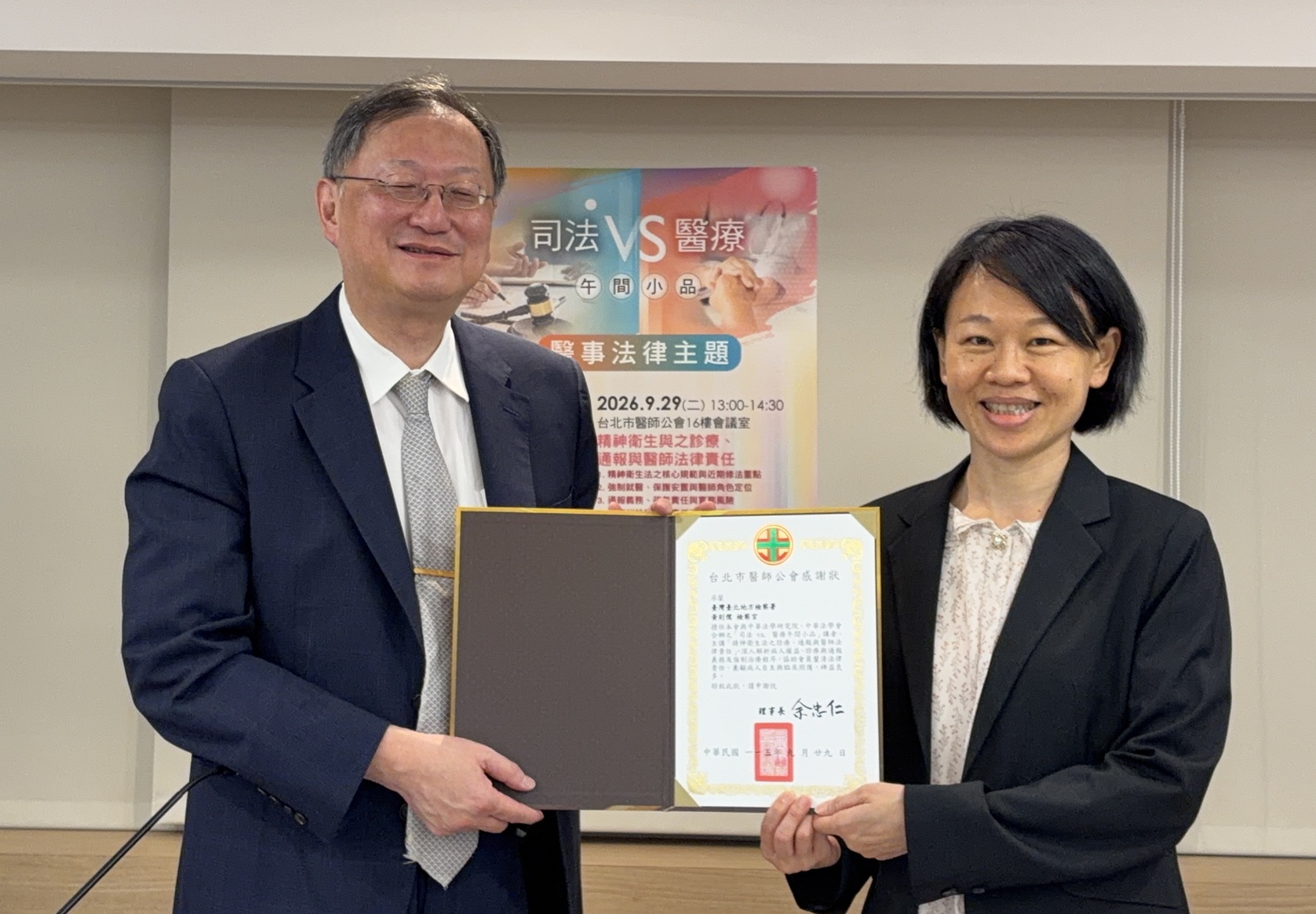
On September 29, 2026, the Taipei Medical Association and the Chung-Hua Institution for Legal Research (the Foundation) held a lunchtime seminar in the "Law vs. Medicine" series at the Taipei Medical Association, co-organized by the Chinese Society of Law.

The topic was "Diagnosis, Treatment, Reporting and Physicians' Legal Liability under the Mental Health Act." Prosecutor Huang Tse-Ju of the Taiwan Taipei District Prosecutors Office was invited as the speaker, and the Foundation was deeply honored that Professor Wu Chien-Chang of the Department of Psychiatry, National Taiwan University Hospital, graciously agreed to serve as discussant. Dr. Chang Meng-Yuan, Executive Supervisor of the Taipei Medical Association, moderated.
The Mental Health Act was substantially amended in 2022, and the new system under which compulsory admission is decided by the courts took effect on August 1, 2026. The seminar helped physicians and legal professionals grasp the key points of the new law.
Opening Remarks
Dr. Yu Chong-Jen, President of the Taipei Medical Association, noted that medical work often needs legal support and expressed his hope that the lunchtime seminars would continue. Dr. Chou Nai-Kuan, Chairman of the Foundation, and Wu Ming-Tzu, President of the Foundation, also gave remarks affirming the exchange between medicine and law.

Opening the session, moderator Dr. Chang Meng-Yuan observed that the direction of mental health law has changed: where it once emphasized management and compulsion, it now emphasizes protecting patients' rights. Dr. Chang also reminded physicians that, beyond treatment, communicating with patients and their families and making reports as required by law are also legal responsibilities.
Key Points of the Lecture
Prosecutor Huang Tse-Ju gave a quick overview of the Mental Health Act and highlighted four key points.
- Shared responsibility across government agencies
The purpose of the new law is not only to treat illness but also to "support and assist patients in living equally in the community." The law assigns responsibilities to more than ten competent authorities, including those for education, labor, justice, national defense, finance and culture, so mental health is no longer the concern of the Ministry of Health and Welfare alone.
- Distinguishing "explaining," "consent" and "informing"
The law sets different requirements for different measures, as summarized below:
|
Measure |
Legal Requirement |
Provision |
|---|---|---|
|
Diagnosing and treating a patient, or arranging admission |
Explain the condition, treatment plan, reasons for admission and related matters to the patient |
Mental Health Act, Art. 30 |
|
Restricting a patient's place of residence or movement |
Obtain the patient's consent, within the minimum necessary scope |
Mental Health Act, Art. 31 |
|
Physically restraining a patient |
Only after informing the patient, with regular reassessment |
Mental Health Act, Art. 32 |
|
Special treatments such as electroconvulsive therapy |
Explain, and also obtain written consent |
Mental Health Act, Arts. 43–44 |
- Notification and reporting must not be overlooked
When a patient is discharged, leaves without permission or goes missing, the family, guardian and competent authorities must be notified; when a patient is diagnosed as a severe patient, the case must be reported to the competent authority. Prosecutor Huang reminded the audience that failing to do so may result in a fine of NT$30,000 to NT$150,000.
- Compulsory admission now decided by the courts
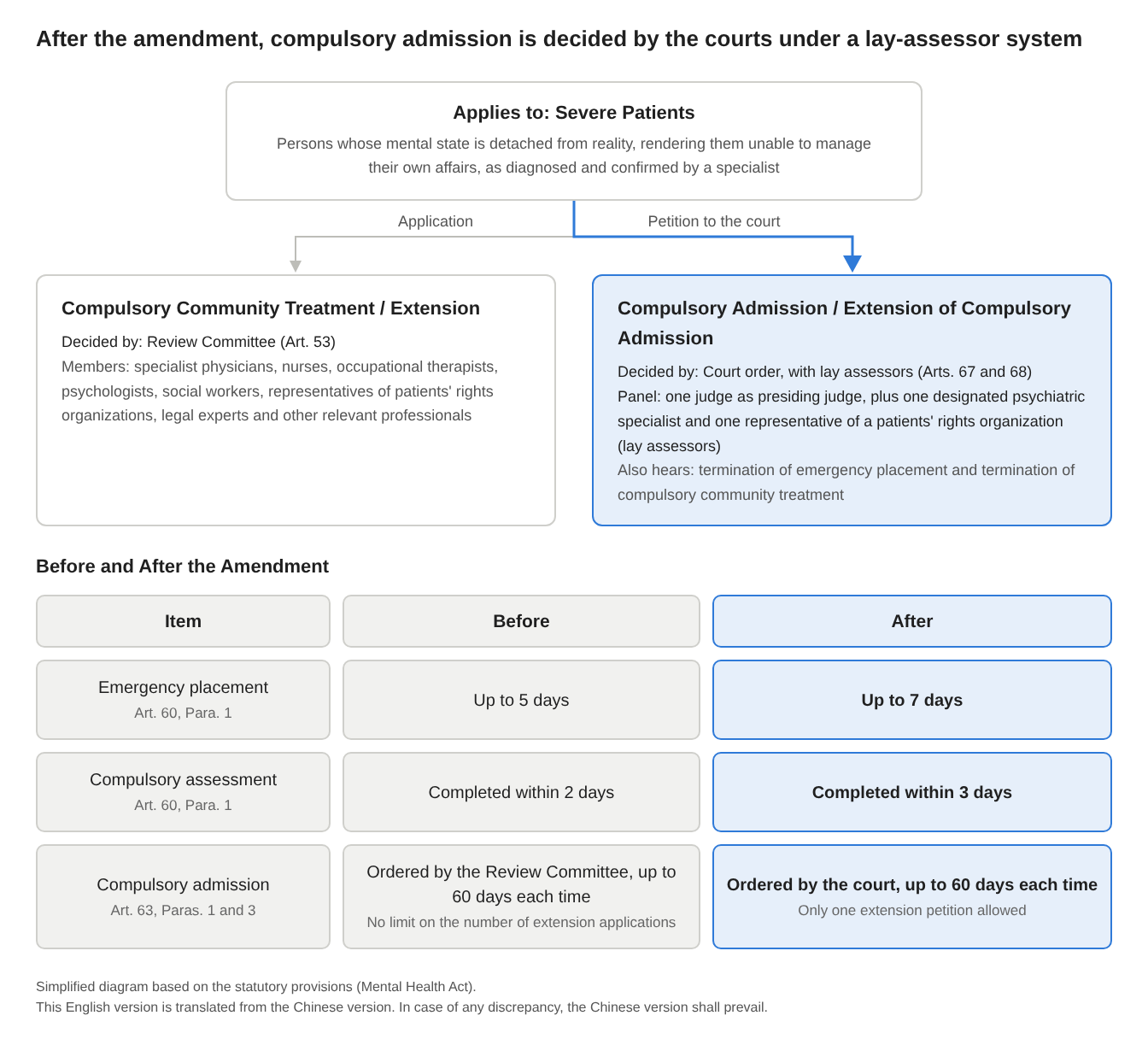
A severe patient who poses a risk of harming others or themselves and refuses admission may first be placed under emergency placement after the statutory procedures; whether compulsory admission is ordered is now decided by the courts. The process is summarized below:
|
Stage |
Content |
|---|---|
|
Emergency placement |
When a severe patient refuses full-time inpatient treatment, emergency placement may be arranged first, for up to 7 days |
|
Court hearing |
Heard by a panel of one judge and two lay assessors (a psychiatric specialist and a representative of a patients' rights organization) |
|
Compulsory admission |
Each court order for compulsory admission may not exceed 60 days |
Prosecutor Huang also shared practical experience: when on duty and encountering a suspect with a mental health condition, a prosecutor may apply to the court for "provisional placement." However, the medical certificate and records must be assembled within 24 hours and a hospital willing to admit the person must be found, which depends on close cooperation among the police, prosecutors and hospitals.
Discussant's Remarks

Professor Wu Chien-Chang, who took part in drafting the amendments, added three points from a physician's perspective:
Electroconvulsive therapy is a strictly regulated treatment. Professor Wu explained that it is now performed under anesthesia, which reduces patients' discomfort, but side effects such as short-term memory effects may still occur. It may be clinically helpful for some patients with severe depression; whether it is appropriate must be assessed individually by a specialist. Because this treatment was highly controversial in the past, the law classifies it as a special treatment and requires that the patient first be given an explanation and that written consent be obtained before it is performed.
Serious conduct does not in itself make someone a "severe patient" under the law. Under the Mental Health Act, a severe patient is a person whose mental state is detached from reality, rendering them unable to manage their own affairs, as diagnosed and confirmed by a specialist. Professor Wu explained that anyone involved in a criminal case, with or without a mental illness, should be handled through criminal procedure and enjoys the same procedural safeguards; if treatment is needed, medical institutions then provide assistance. This reflects the principle of equal treatment set out in the Convention on the Rights of Persons with Disabilities, with the justice and medical systems each fulfilling their own roles.
Compulsory admission is a last resort. Professor Wu pointed out that excessive compulsory treatment may cause some patients to resist treatment and may even affect their willingness to seek care in the future. Drawing on his outpatient experience, he described a family that asked for a patient in low spirits to be admitted compulsorily at once; on assessment, however, the patient did not meet the criteria for a severe patient. The medical team first built a therapeutic relationship with the patient and discussed care arrangements with the family, and the patient ultimately agreed to voluntary admission. Professor Wu believes that building trust between doctor and patient is the way to gradually reduce compulsory admissions.
Open Discussion
Participants on site and online raised the following questions:
|
Question |
Response |
|---|---|
|
Can prisoners refuse psychiatric treatment? |
Professor Wu said that, in principle, a patient's autonomous decision should be respected, and the same applies to prisoners; however, whether an individual can refuse and how a refusal is handled depend on the patient's condition and the relevant laws, and cannot be generalized. |
|
Does compulsory admission violate the Convention on the Rights of Persons with Disabilities? |
The UN Committee considers that it does, but no country has yet truly abolished compulsory admission; Taiwan's approach is to safeguard patients' rights as fully as possible through procedure. |
|
How should community support and medical care be distinguished? |
Community groups may help patients with daily living and accompany them to medical appointments, but may not provide diagnosis or treatment themselves. |
Conclusion
The amended Mental Health Act moves psychiatric care from "managing patients" to "protecting patients." By understanding what the law requires, physicians can care for their patients while also protecting themselves.
Further Reading
- 【Law vs. Medicine】Health Lecture – Mental Health Inside and Outside the Courtroom – The Importance of Balancing Body and Mind
- 【Law vs. Medicine】Legal Lecture – Legal Risks Every Primary Care Physician Should Know
This English version was prepared with the assistance of AI. Please refer to the Chinese text for accuracy.
------------------------------
Referenced Laws
- Mental Health Act (Art. 1: purpose; Art. 3: definitions, including severe patients; Arts. 30–33: explanation, consent, restraint and discharge notification; Arts. 43–44: special treatments and written consent; Art. 45: reporting of severe patients; Art. 52: notification when a patient leaves or goes missing; Arts. 59–60: emergency placement; Art. 63: duration of compulsory admission; Art. 67: panel of one judge and two lay assessors; Art. 82: fines)
- Code of Criminal Procedure (Art. 121-1: provisional placement)
- Act to Implement the Convention on the Rights of Persons with Disabilities
※ All links lead to the Laws & Regulations Database of the R.O.C. (Taiwan), which may be updated with some delay, and English translations may lag behind the Chinese text. The latest version of the law currently in force shall prevail.
------------------------------
Zusammenfassung
【Recht vs. Medizin – Rechtsvortrag: Diagnose, Behandlung, Meldepflichten und ärztliche Haftung nach dem Gesetz über die psychische Gesundheit】
Am 29. September 2026 veranstalteten die Taipei Medical Association und die Chung-Hua Institution for Legal Research (die Stiftung) gemeinsam mit der Chinese Society of Law ein Mittagsseminar der Reihe „Recht vs. Medizin“. Es referierte Staatsanwalt Huang Tse-Ju von der Staatsanwaltschaft Taipeh; als Diskutant wirkte Prof. Wu Chien-Chang von der Psychiatrischen Abteilung des National Taiwan University Hospital mit, die Moderation übernahm Dr. Chang Meng-Yuan von der Taipei Medical Association.
Staatsanwalt Huang erläuterte vier Kernpunkte des 2022 umfassend reformierten Gesetzes: die geteilte Verantwortung vieler Behörden, die unterschiedlichen Anforderungen an Aufklärung, Einwilligung und Information der Patientinnen und Patienten, die Benachrichtigungs- und Meldepflichten sowie die seit dem 1. August 2026 geltende gerichtliche Entscheidung über die Zwangsunterbringung durch einen Spruchkörper aus einem Berufsrichter und zwei Laienbeisitzern. Prof. Wu betonte, dass die Zwangsunterbringung das letzte Mittel sein müsse und Vertrauen zwischen Arzt und Patient häufig zu einer freiwilligen Behandlung führe.
Diese Zusammenfassung wurde mit Unterstützung von KI erstellt. Maßgeblich ist der chinesische Text.
------------------------------
要約
【司法vs.医療 司法講座 精神衛生法における診療・通報と医師の法的責任】
2026年9月29日、台北市医師公会と財団法人中華法学研究院(以下「本法人」)は、中華法学会との共催により、「司法vs.医療ランチタイム講座」を開催しました。台湾台北地方検察署の黄則儒検察官を講師に、台湾大学病院精神医学部の呉建昌教授をコメンテーターにお迎えし、台北市医師公会の張孟源常務監事が司会を務めました。
黄検察官は、2022年に大幅改正された精神衛生法について、各省庁による責任の分担、説明・同意・告知の区別、通知・通報義務、そして2026年8月1日から施行された、裁判官1名と参審員2名による強制入院の裁判所決定制度という4つの要点を解説しました。呉教授は、強制入院は最後の手段であり、医師と患者の信頼関係が自発的な治療につながることが多いと強調しました。
本要約は AI の支援を受けて作成したものです。正確な内容については中国語の本文をご参照ください。