Shih Hsin University School of Law and the Chung-Hua Institution for Legal Research Co-host the International Conference "Normative Transformation and Institutional Challenges of Digital Governance"
Background
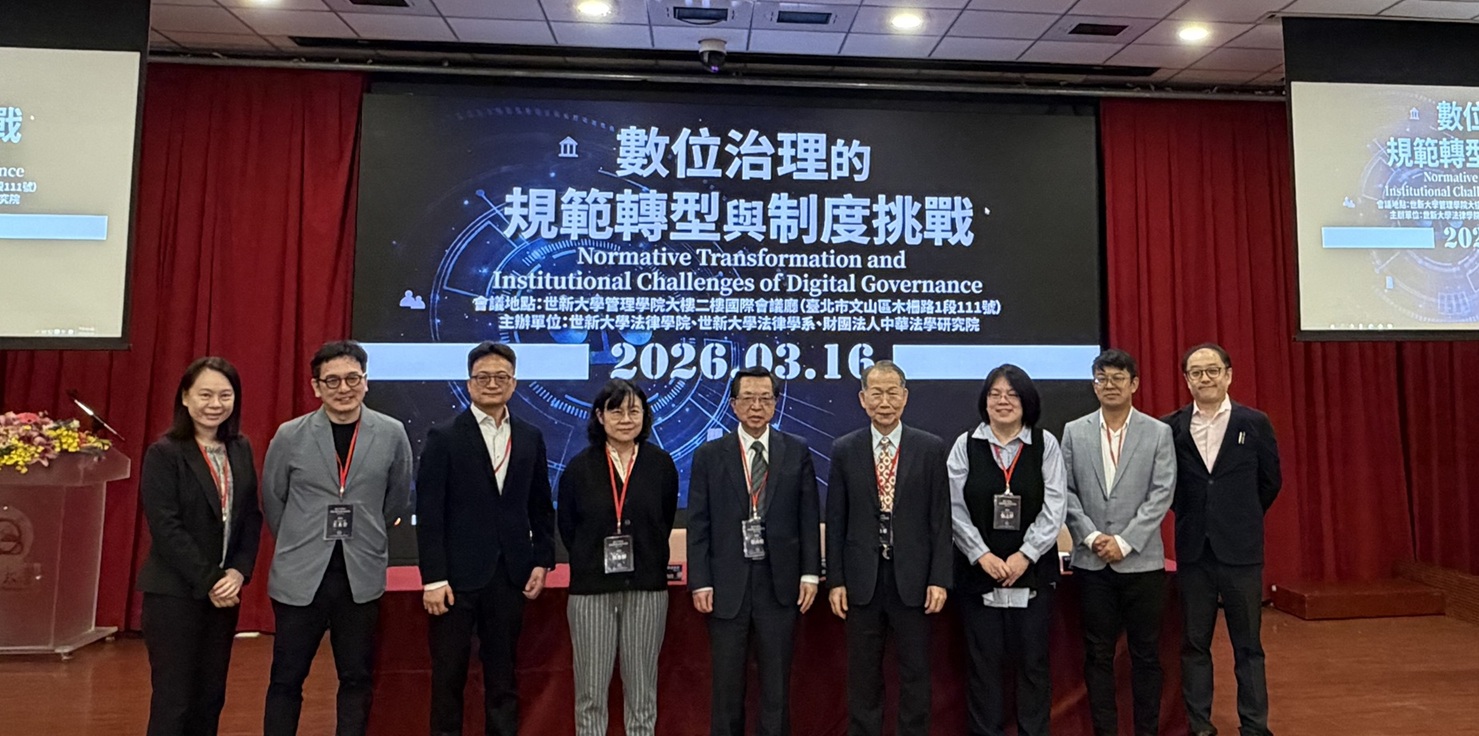
On March 16, 2026, the School of Law and the Department of Law of Shih Hsin University and the Chung-Hua Institution for Legal Research (the Foundation) jointly held the international conference "Normative Transformation and Institutional Challenges of Digital Governance" at the International Conference Hall of the College of Management Building, Shih Hsin University. As the university approaches its 70th anniversary, the conference brought together scholars from Taiwan, Germany and Austria for a full day, from 9 a.m. to 4 p.m., to examine how digital technology is reshaping the legal order.
From generative AI and drones to digital sexual imagery, new technologies often move faster than the law can respond. The conference comprised four sessions, with six paper presentations and two keynote lectures by foreign scholars. Spanning administrative, civil and criminal law, it offered participants a view of digital governance across different fields of law.
Opening Remarks
Vice President Lin Heng-chih of Shih Hsin University, Chairman Chou Nai-kuan of the Foundation, and Dean Yeh Yun-ching of the School of Law delivered opening remarks in turn.
Vice President Lin noted that the law is often left to catch up under the pressure of technological change, which makes interdisciplinary and systematic academic dialogue all the more important.
Chairman Chou congratulated the university on its upcoming 70th anniversary and drew on his early research on electrocardiogram chips and genomics, where every step, from soldering circuit boards to analyzing data, depended on advances in technology. He observed that a large research project, from setting its aims and designing its steps to keeping records and undergoing review, involves the same division of responsibility and risk management as an administrative procedure, and that medical ethics review and legal ex ante review have much in common.
Dean Yeh described the conference as an important outcome of the collaboration between the School of Law and the Foundation, and expressed the hope that it would clarify how procedural design, substantive rights and criminal risks intersect in digital governance.
Conference Sessions
Morning: Administrative Procedure, Police Powers and Digital Markets
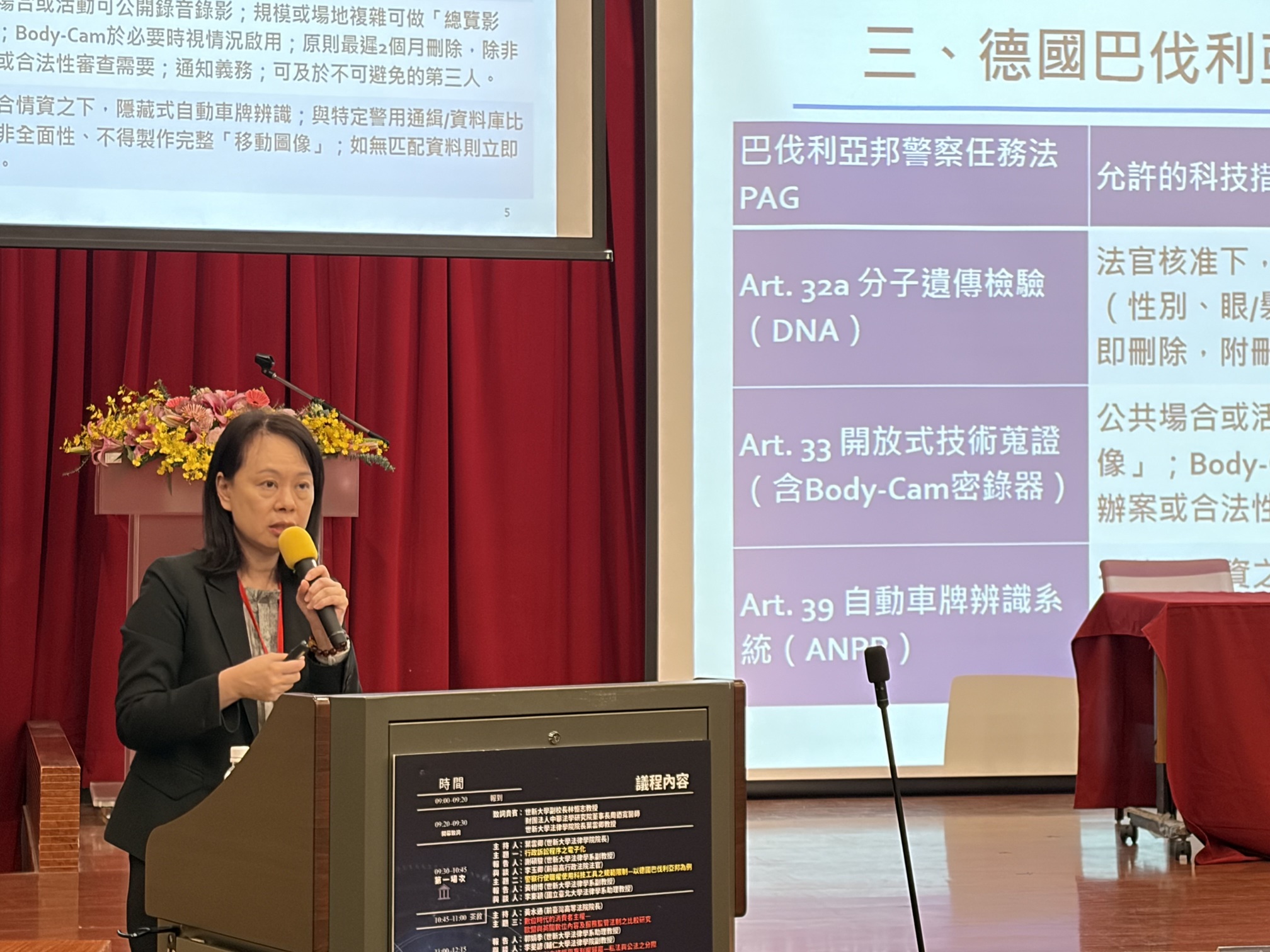
Session One was chaired by Dean Yeh Yun-ching. Associate Professor Hsieh Shuo-chun of the Department of Law, Shih Hsin University, presented "The Digitalization of Administrative Litigation Procedure," with former Supreme Administrative Court Justice Li Yu-ching as discussant. Associate Professor Huang Hsiang-po of the same department examined the legal limits on police use of technological tools, taking the Free State of Bavaria in Germany as an example, with Assistant Professor Li Tung-ying of the Department of Law, National Taipei University, as discussant.
After a tea break, Session Two, chaired by Huang Shui-tung, former President of the Taiwan High Court, turned to digital markets and intellectual property. Assistant Professor Kuo Chuan-chi of the Department of Law, Shih Hsin University, compared the regulation of digital content and services in the EU and the UK to explore consumer sovereignty in the digital age, with Associate Professor Li Yu-yen of the College of Law, Fu Jen Catholic University, as discussant. Professor Lin Chou-fu of the Department of Law, Chinese Culture University, analyzed how the right to apply for a patent and patent ownership are determined at the boundary between private and public law, with Li Wei-hsin, former Chief Judge of the Intellectual Property and Commercial Court, as discussant.
Afternoon: Criminal Investigation and Digital Sexual Imagery
Session Three, chaired by Grand Justice Tsai Ching-yu (Emeritus) of the Judicial Yuan, focused on criminal law. Assistant Professor Chang Chih-ping of the Department of Law, Shih Hsin University, focusing on Article 153-3 of the Code of Criminal Procedure, examined whether investigations by administrative drones may serve as the starting point of a criminal investigation, with Associate Professor Hsu Chi-yi of the Department of Law, Fu Jen Catholic University, as discussant. Professor Wang Yu-chuan of the same department, centering on Chapter 28-1 of the Criminal Code, discussed the regulation of digital information and sexual imagery, with Project Assistant Professor Chung Hung-pin of the Department of Law, Ming Chuan University, as discussant.
Closing Session: Keynote Lectures by German and Austrian Scholars
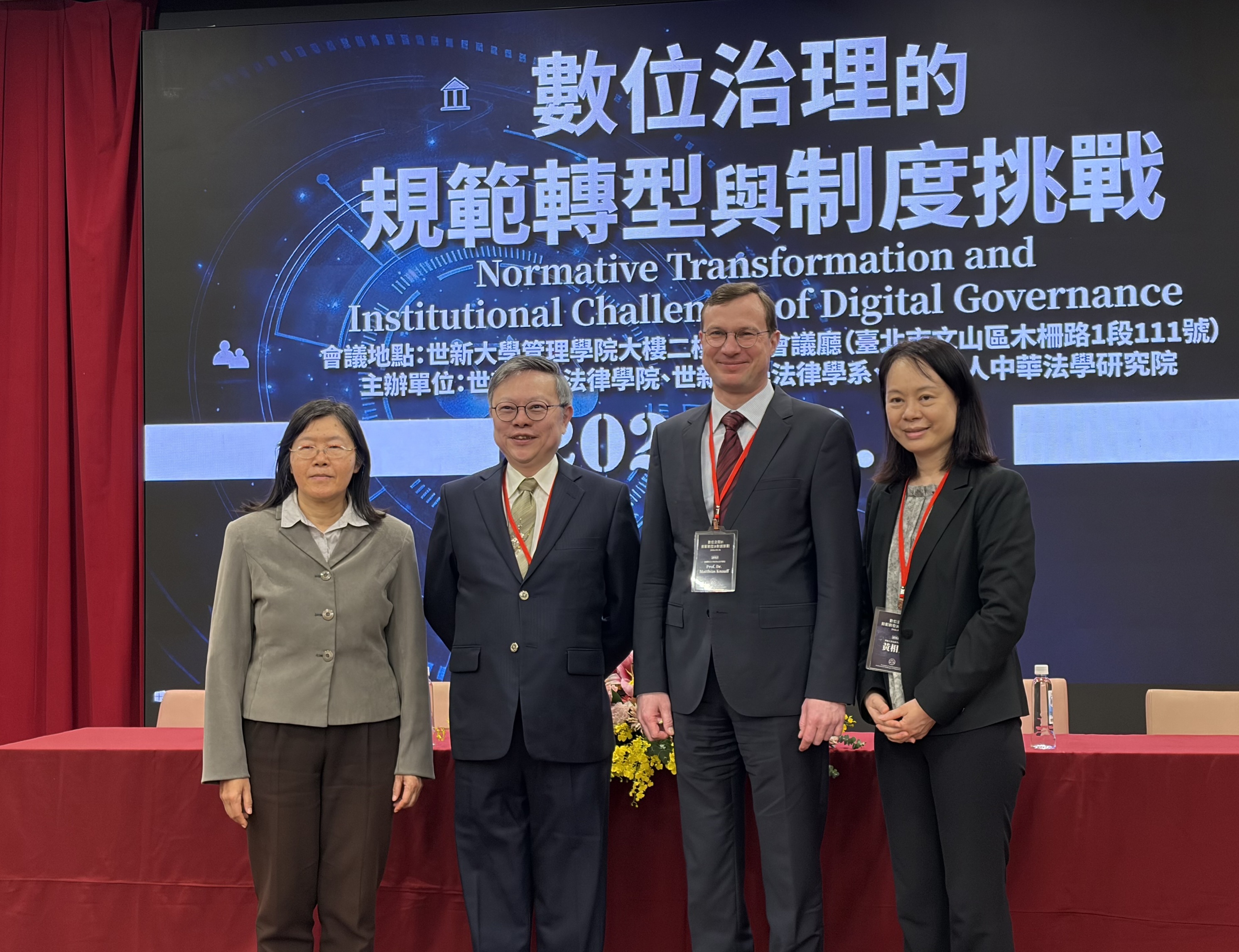
The final session, chaired by Associate Professor Wang Yu-chi of the Department of Law, Shih Hsin University, invited two European public law scholars to share an international perspective.
Prof. Dr. Matthias Knauff, Professor of Public Economic Law at the University of Jena, Germany, spoke on "State and Justice in the Digital Age: Challenges and Perspectives." Moving from digital sovereignty and the application and enforcement of law in digital space to the pressures that digital surveillance and platform algorithms place on freedom and democracy, he reminded the audience that, in pursuing efficient law enforcement, the state must remain anchored in sovereignty, fundamental rights and democratic legitimacy.
Dr. Matthias Zußner, Postdoctoral Researcher at the Institute of Public Law and Political Science, University of Graz, Austria, followed with "The Use of AI by Public Administrations in Austria." He introduced cases and the legal framework for the use of AI by Austrian administrative authorities, and explained how decision transparency, algorithmic bias and human oversight are addressed under existing administrative procedure and data protection rules.
Concluding Remarks
From administrative procedure in the morning and criminal investigation in the afternoon to the perspectives of European scholars, the conference spent a full day mapping the challenges that digital governance poses across fields of law. The Foundation thanks the School of Law and the Department of Law of Shih Hsin University for their collaboration, as well as all presenters, discussants and participants, and will continue to work with academia to follow the impact of technological development on the legal system and the protection of rights.
This English version was prepared with the assistance of AI. Please refer to the Chinese text for accuracy.
Zusammenfassung (Deutsch)
Internationale Konferenz „Normativer Wandel und institutionelle Herausforderungen der digitalen Governance“ (16. März 2026)
Am 16. März 2026 veranstalteten die Juristische Fakultät und das Department für Rechtswissenschaft der Shih-Hsin-Universität gemeinsam mit der Chung-Hua Institution for Legal Research (der Stiftung) an der Shih-Hsin-Universität eine internationale Konferenz zur digitalen Governance. Grußworte sprachen Vizepräsident Lin Heng-chih von der Shih-Hsin-Universität, der Vorsitzende der Stiftung, Chou Nai-kuan, sowie Dekan Yeh Yun-ching von der Juristischen Fakultät.
In drei Sitzungen wurden sechs Beiträge vorgestellt: zur Digitalisierung des Verwaltungsprozesses, zum Einsatz technischer Mittel durch die Polizei, zu Verbraucherrechten im digitalen Zeitalter, zur Zuordnung von Patentrechten, zu Verwaltungsdrohnen als Ausgangspunkt strafrechtlicher Ermittlungen sowie zu digitalen sexuellen Bildaufnahmen nach dem taiwanischen Strafgesetzbuch.
In der Abschlusssitzung sprach Prof. Dr. Matthias Knauff (Universität Jena) über „State and Justice in the Digital Age: Challenges and Perspectives“. Anschließend stellte Dr. Matthias Zußner (Universität Graz) seinen Vortrag „The Use of AI by Public Administrations in Austria“ vor.
Diese Zusammenfassung wurde mit Unterstützung von KI erstellt. Maßgeblich ist der chinesische Text.
要約(日本語)
国際学術シンポジウム「デジタル・ガバナンスにおける規範の転換と制度的課題」(2026年3月16日)
2026年3月16日、世新大学法律学院・法律学科と財団法人中華法学研究院は、世新大学においてデジタル・ガバナンスをテーマとする国際学術シンポジウムを共催しました。開会式では、世新大学の林恒志副学長、中華法学研究院の周迺寬理事長、法律学院の葉雲卿学院長が挨拶を述べました。
三つのセッションでは、行政訴訟手続の電子化、警察による科学技術の利用、デジタル時代の消費者の権利、特許権の帰属、行政ドローンによる調査と刑事捜査の関係、台湾刑法におけるデジタル性的画像の規制という六つのテーマについて論文が発表されました。
最終セッションでは、イェナ大学の Matthias Knauff 教授が「State and Justice in the Digital Age: Challenges and Perspectives」を、グラーツ大学の Matthias Zußner 博士が「The Use of AI by Public Administrations in Austria」を題として講演しました。
本要約は AI の支援を受けて作成したものです。正確な内容については中国語の本文をご参照ください。